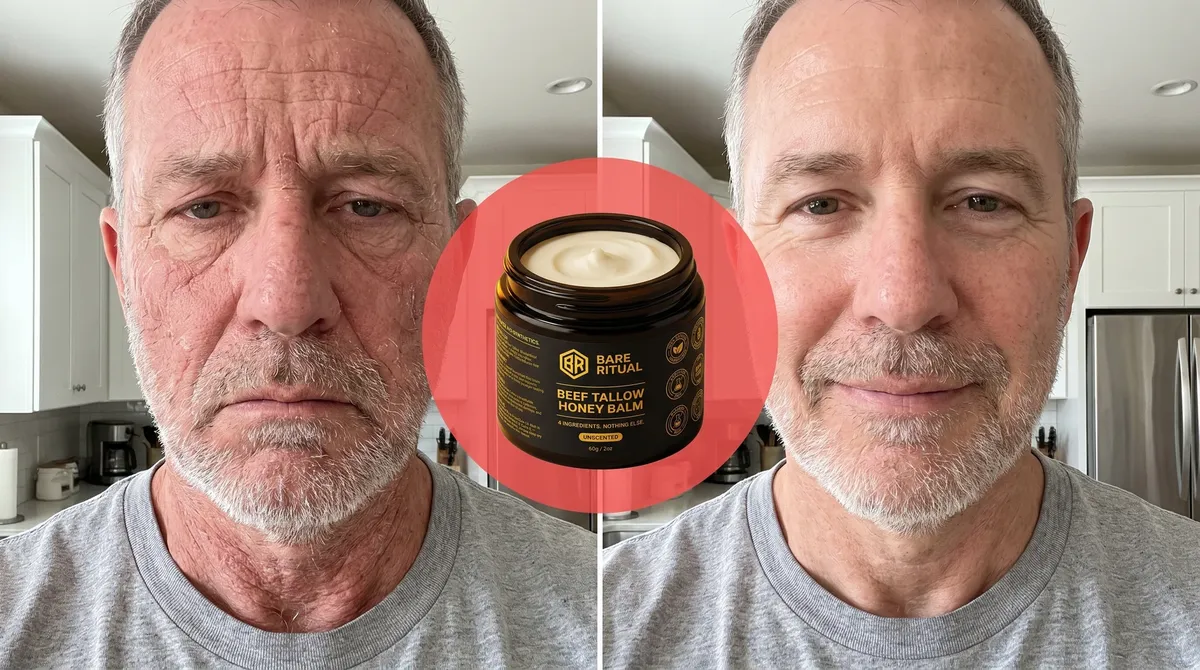
Winning ad scripts
WINNING ANGLE: “Subtraction + Sebum Match”
You don’t need to add more to your skin, you need to remove what it can’t use. Tallow is molecularly the same as your own oil, so your skin recognizes it and absorbs it. One jar replaces the shelf.
Every script hits the same four beats in some order:
- The enemy — synthetic/vegan creams are mostly water and fillers; they sit on top and evaporate (or worse, wreck your barrier)
- The mechanism — tallow has nearly the same fatty acid profile as sebum, so it melts in instead of sitting on top, and carries vitamins A, D, E, K
- The simplification — four ingredients, one product, done
- The payoff proof — “someone asked if I’d had Botox”
Bare Ritual’s twist on it is adding the “after 40 your sebum production drops” step in front, which makes it a men’s-40+ story instead of a generic natural-skincare story.
HERE ARE WINNING TRANSCRIPTS THAT USE THIS ANGLE:
1. Ancestral Cosmetics — “Needles? No thanks.”
63 sec · live 398 days · the cleanest full-arc version
Slathering your face with vegan skincare filled with lab-made chemicals you can’t pronounce isn’t a flex. It’s how you wreck your skin barrier and make it look three times worse than it did before.
We prefer to make skincare the way our ancestors did, using real ingredients that have kept skin clear and youthful for thousands of years.
Our tallow and honey balm is made with the highest-quality Irish grass-fed tallow, sourced from cows that graze mineral-rich pasture more than 300 days per year. We hand-render and purify in-house to create the cleanest, most potent tallow on the planet. Because if we wouldn’t use it on our own kids, it doesn’t go in the jar.
Tallow is nearly identical to your skin’s natural oils. It doesn’t just sit on top — it melts deep, restoring your barrier and delivering vitamins like A, D, E and K straight where your skin needs them. Then add raw Irish honey, cold-pressed olive oil and local beeswax — a combo that deeply hydrates, soothes inflammation, and leaves you with that glowy, bouncy skin that will have people asking if you got Botox.
Don’t fall for the lie that skincare has to be packed with 14-step formulas and ingredients you can’t pronounce. Thousands have already made the switch. Try it and you’ll feel the difference — and so will everyone who sees your face.
2. Bare Ritual — “Someone asked me if I’d had Botox”
61 sec · live 81 days · runs to the advertorial · the men’s-40+ version of the mechanism
Someone asked me last week if I’d had Botox. I haven’t.
Nobody told me my skin was getting worse, so I had to figure that out myself. Yeah — nobody told me this, and I’m a bit annoyed by it.
After 40, your skin stops producing as much of its own oil. It’s called sebum. Your body made it your whole life. It’s what kept your skin thick, structured and functional. When production drops, that’s when everything starts changing. Lines get deeper. The texture gets rough. You start looking older than you actually feel.
Here’s the part that got me: every moisturizer I’d used before was never going to fix it. Doesn’t matter how expensive it was. Synthetic creams are molecularly too different from sebum — they can’t replicate it. They sit on the surface, feel like something’s happening, then — boom — evaporate.
Beef tallow has almost exactly the same fatty acid profile as sebum, so your skin absorbs it the same way it would absorb the oil it made itself.
This is what I’ve been using for the past couple of months. Four ingredients: grass-fed beef tallow, raw honey, beeswax, olive oil.
I’m not saying it’s magic. I’m just saying the biology makes sense in a way that nothing else I’ve ever tried has. Ever.
3. Bare Ritual — “I tried 8 different beef tallows”
74 sec · live 194 days · their longest runner · skeptic-convert + authority + scarcity
I’m the guy that tried eight different types of beef tallow, because I learned that all the store-bought lotions in big-box stores are owned by three corporations, and all they want to do is poison you and get your money.
This is the beef tallow I’ve been using for the last 180 days. This stuff right here. Four ingredients. No dyes, toxins, fragrances, chemicals — none of that stuff — because it only has grass-fed beef tallow, organic olive oil, beeswax and honey. Best-smelling beef tallow you’ll find, right here. The consistency, even better.
Dr. Berg is originally the one who recommended I use this stuff on my skin as an alternative to all those moisturizers, because it’s loaded with vitamins A, D, E and K, which actually nourish your skin from the outside in. It’s also non-comedogenic, which means it will not clog your pores, won’t cause pimples or anything like that. It’s also said to mimic the natural oil our skin produces, which helps eliminate wrinkles, fine lines and age spots. It’s antibacterial, antimicrobial, anti-inflammatory because it has beeswax, honey and olive oil inside of it — which is probably why people who have acne, rosacea, eczema, all kinds of skin issues are switching to beef tallow and having great results.
Don’t trust me, trust the reviews. 520,000 units sold on this platform alone, because it’s the best beef tallow on here. They also have a lavender version for ladies — I got this one for my wife, because their stuff is selling out like crazy, especially going into wintertime when everyone gets that dry skin.
4. Bare Ritual — “Gym Botox” (jar-fill-line proof)
54 sec · ran 120 days · the visual-proof version
I don’t know if that’s the ultimate compliment or what, but this is the only thing I’m using on my face right here. Four ingredients: grass-fed beef tallow, olive oil, beeswax and honey.
In 57 days, that’s what my jar looks like. I’ve got that much left — that’s the fill line right there — because this balm is so rich, a little bit goes a long way.
The reason I started using beef tallow on my face is because it’s loaded with vitamins A, D, E and K, which nourish your skin from the outside in. Beef tallow is said to mimic the same oil that our skin naturally produces, which eliminates fine lines, wrinkles and age spots. This particular beef tallow is also antibacterial and antimicrobial because of the beeswax and honey.
I went with the unscented version. Heard that might be sold out right now, but they also have citrus and lavender for the ladies. So if you want to save money, stop putting toxins on your skin, pick up a beef tallow. Four ingredients, that’s it. Super simple, super hydrating. I’ll link it below right there.
Deep research
Voice-of-Customer Intelligence: Men’s Beef Tallow Skincare Balm (Bare Ritual)
Market-language research to support “Subtraction + Sebum Match” advertorial development
TL;DR
- The winning emotional core is grief over a face that no longer matches the man inside it — men 40–65 don’t want “glow,” they want to stop being asked “are you tired?” and to stop seeing their father when they look in the mirror. The “Subtraction + Sebum Match” angle works because it converts a feminine-coded act (skincare) into a masculine, mechanical, ancestral one (“you don’t add, you remove”; “engine oil for your face”).
- The mechanism is partly defensible and partly folk belief, and copy must respect the line: tallow’s fatty-acid profile genuinely resembles human sebum (oleic/palmitic/stearic), which is real and citable; but “carries vitamins into deeper skin layers / feeds living cells / reverses wrinkles” is marketing, and dermatologists actively push back that tallow is occlusive and comedogenic. Keep claims on the “matches / absorbs / barrier” side, not the “cures/penetrates/nourishes cells” side.
Key Findings
- The trigger is almost always visual and involuntary — a photo, a reflection in a store window, a passport/license photo, being mistaken for the grandfather. Men don’t decide to care; they get ambushed. “I looked in the mirror and saw my father.” (r/AskOldPeople, ~1.3K-comment thread). “It was me. Gasp… ‘If I saw you walking down the street I wouldn’t recognize you at all.’” (Substack commenter).
- “You look tired” is the recurring wound phrase, made worse because strangers say it. Men experience aging as being misread — looking more worn-out than they feel inside. This is exactly Bare Ritual’s headline territory (“Stop looking older than you feel”). Mount Sinai’s Dr. Joshua Zeichner confirms male patients ask “am I aging or am I just tired?” “constantly.”
- Men’s skincare identity is defensive: “I just use soap and water,” “both are for pvssies,” “seems strange to me that guys use actual skin care products” (AnandTech forums). The product must give them permission — the four-ingredient, 30-second, one-jar framing removes the “I’m not that kind of guy” objection.
- The wife/girlfriend is the #1 purchase catalyst. Women buy it, gift it, and nudge. Bare Ritual’s own testimonial leans on this: “My wife asked what I was doing differently — she noticed before I mentioned anything.”
- The mechanism has a genuine kernel: human sebum is roughly 41% oleic / 25% palmitic / 12% stearic acid, and grass-fed tallow lands strikingly close (~47/27/18). The Latin sebum literally means tallow (Thody & Shuster, 1989). This is the most defensible, most persuasive fact in the entire arsenal.
- Dermatologists are the organized opposition. MD Anderson’s Dr. Mika Tabata: “It’s a very extreme moisturizer… It is composed of fatty acids that kind of mimic our own oil that we make. I would personally not put it on my face for concern of adding oils. For anyone prone to acne, I’d be very concerned about it causing acne.” Scripps’ Dr. E. Victor Ross warns “those with acne-prone skin, oily skin or sensitive skin should be careful as they are more likely to experience pore clogging or breakouts,” and Tufts dermatologists call it “highly comedogenic.” This is a live objection that must be pre-empted, not ignored.
- The belief system is carnivore/ancestral/anti-“Big Skincare”: seed oils framed as industrial lubricant, parabens/phthalates as endocrine disruptors, “three corporations own all the lotions,” Dr. Berg / RFK-adjacent wellness framing. This audience wants to believe the cosmetics industry is hiding tallow from them — Bare Ritual’s own copy already plays this note (“Most men’s moisturizers are built on parabens and phthalates — synthetics classified as endocrine disruptors. Look it up, then read my label.”).
- Price resistance is real ($99.99 one-time for a 2oz/60g jar). The BOGO / Buy-2-Get-2 / subscribe framing and “one jar replaces the whole shelf” math are the counters.
- Texture/smell/greasy and “beef fat on my face” are the visceral objections; the triple-filtered-odorless claim and “no greasy feeling” reviews directly answer them.
Details
SECTION 1 — THE AVATAR CONFESSION (~300-word advertorial opener, in-voice)
I’m 57 and I never bought a skincare product in my life. Soap and water. That was the whole routine, and I was kind of proud of it — that stuff was for other people, not for me.
Then my daughter took a picture of me at her graduation. I looked at it later that night, everybody else asleep, and I didn’t recognize the guy. Tired. Gray. Kind of leathery around the neck, deep lines I swear weren’t there a year ago. I looked like my father. Not “distinguished.” Just… worn out. And the thing that got me — I didn’t feel worn out. Inside I felt like the same guy. The face didn’t get the memo.
It’s the little stuff that piles up. The barber spins you around under those lights and there you are. The passport photo you can’t believe is you. Some kid at work asks if you’re feeling okay, if you got any sleep. You start turning off your own camera on video calls so you don’t have to watch yourself.
My wife had been telling me for a year to put something on your face, for God’s sake. I always said the same thing — half those products, the label sounds made up, water and chemicals I can’t pronounce, sixty bucks for a tiny jar. I’m not doing a twelve-step routine. I’m a grown man.
So when she showed me this tallow thing — beef fat, basically, four ingredients, the same fat your own skin used to make — I laughed. Then I read the label. Four things. All of them real. And I thought: what exactly am I so afraid of? Looking like myself again?
SECTION 2 — THE OBJECTION MATRIX
| The objection (their words) | Where it shows up | Proof element that dissolves it |
|---|---|---|
| “It’s beef fat on my face.” / “rubbing beef dripping on my face” | Substack, TikTok (“I’d be mortified”), press | Reframe as sebum-match: tallow is “the closest natural match to the oil your skin already makes”; the word sebum literally means tallow. Four-ingredient label. |
| “Will it smell like a steakhouse / hamburger?” — “picture dinner following them into the bathroom” | brand FAQs, Substack (“will I smell like meat?”) | Triple-filtered; unscented “smells like nothing — no beef, no perfume.” Trustpilot 4★: “barely has any smell to it.” Lavender/Citrus options. |
| “Isn’t it greasy?” | Amazon/Woot | Pea-sized, 30 seconds, “absorbs in instead of sitting on top.” Cite “leaves the skin soft with no oily feel” reviews. |
| “Won’t fat clog my pores / break me out?” | MD Anderson, Scripps, NBC-quoted derms | Position for dry/mature 40+ skin (low sebum), not oily/acne skin. 90-day guarantee absorbs the risk. Do NOT claim blanket “non-comedogenic” — it’s contested. |
| “$100 for 2 ounces is insane.” | King Tallow review, Amazon dupes | “One jar replaces the whole shelf.” Pea-sized = ~2 months/jar. BOGO / Buy-2-Get-2 / Subscribe 20%. As skin improves you use less. |
| “I’m a guy, I don’t do skincare / 12-step routines.” | AnandTech, r/malegrooming | One product, one step, 30 seconds, morning. “Not a 12-step routine.” Veteran-owned, built-for-men framing. |
| “My wife’s expensive cream didn’t work, why would this?” | Woman’s World, forums | Different mechanism: her cream is water + fillers that evaporate; this matches skin’s own oil. |
SECTION 3 — THE TRANSFORMATION TIMELINE (in their language)
- Day 1 (the feel): “Went on lighter than I expected. Thought beef fat would sit there greasy — it kind of drank in.” Set expectation: skin feels less tight by end of day one.
- Week 1: “Morning dryness is gone. Face doesn’t feel tight by noon anymore.” Rough/coarse texture smooths first — the “sandpaper,” “rough hands in the work truck” complaints ease.
- Week 2 (PDP promise — “most men notice a real difference within two weeks”): “The fine lines around my eyes looked softer. Not gone — I’m not delusional — but softer.” First “did you do something different?” from the wife.
- Week 4–5: “Redness calmed down. Skin looks healthier than it has in years.” Matches Bare Ritual’s own 5-week testimonial pattern.
- Day 57 (the “Gym Botox” jar-fill-line visual): Show the physical proof — how far the jar dropped. “One jar, almost two months, and my face looks like this.”
- Day 90 (payoff + guarantee window closes): “Someone asked if I’d had Botox.” Reframe: “If you’re not the guy in the mirror you want to be by now, I refund every cent.”
SECTION 4 — THE MECHANISM STORY (defensible vs. folk belief)
The metaphor stack they already believe:
- Engine oil (Bare Ritual’s own): “You wouldn’t put synthetic solvent in a high-performance engine. Don’t put it on your face either.” Tallow is the right-grade oil; synthetic creams are the wrong solvent.
- Topping off the tank: skin’s lipid-recognition treats tallow “like a topped-off tank, not an invader.”
- Native language: “Tallow speaks your skin’s biochemical language” — it doesn’t have to be translated, so it absorbs instead of sitting on top.
- The after-40 setup (the twist that makes it a men’s story): “Your skin runs on the oil it makes itself. As it ages it makes less — so the surface goes coarse and rough.” Then tallow as the replacement.
Scientifically SUPPORTED (safe to claim):
- Tallow’s major fatty acids (oleic ~47%, palmitic ~27%, stearic ~18%) closely resemble human sebum (~41/25/12). “Skin-identical / biocompatible” is defensible ingredient-literature language.
- The word sebum is Latin for tallow (Thody & Shuster, Physiol Rev, 1989) — real and evocative.
- Tallow is an effective occlusive/emollient that slows water loss and can help dry, barrier-compromised skin.
- Sebum production does decline with age — Pochi, Strauss & Downing (J Invest Dermatol, 1979): “From the twenties on, there is a decline of about 23 percent per decade in men and about 32 percent per decade in women.” Important nuance to keep copy honest: the same research and Zouboulis & Boschnakow (Clin Exp Dermatol, 2001) find “no major changes appear until the eighth decade of life in men” — men’s surface-sebum drop is later/slower than the pitch implies. Keep it soft: “as skin ages it tends to make less oil and hold moisture less well,” which is broadly true and matches the PDP’s own hedged wording.
MARKETING / FOLK BELIEF (do NOT state as fact — defensibility risk):
- “Carries vitamins A, D, E, K into deeper layers to feed living cells” — unproven; vitamins present ≠ delivered/active.
- “Reverses/removes deep wrinkles,” “replaces Botox” — comparison framing only. Bare Ritual’s own table already frames it against Botox rather than as equivalent — stay there.
- “Balances oil production,” “non-comedogenic for everyone” — contested; MD Anderson, Scripps, Tufts and NBC-quoted derms warn of clogged pores/acne on a delayed (~8-week) cycle for oily/acne-prone skin.
- FDA/safety: Peach Dermatology warns “Tallow can harbor bacteria if not properly rendered, stored, or preserved… this introduces a risk of infection.” This is why “triple-filtered / verified sourcing / made in USA” claims must be literally true.
- “Big Skincare doesn’t want you to know” / “switched to water and fillers to sell you more” — belief-resonant but a claim about intent; keep as rhetorical framing, not stated fact.
SECTION 5 — THE CREDIBILITY SCRIPT (what makes THEM believe)
- Show the label, not the lab. “Read the label — that’s the whole pitch. Four things: grass-fed beef tallow, raw honey, beeswax, olive oil.” The skeptic distrusts products “where half the label sounds made up.” Radical ingredient transparency is the strongest trust lever.
- A named, real, veteran human. The founder must be visible — face, name, “I use it myself every single day.”
- The fear, named first. “That’s the fear with tallow — and it’s a fair one, because badly-rendered tallow does smell. Ours is triple-filtered.” Naming the objection before they do converts skeptics.
- Volume + peer proof. 470,000+ jars, 8,672 reviews, 4.8 avg, “471,889 men.” Peer-shaped (“men like me,” “not a skincare guy at all”).
- Authority the tribe already trusts. Dr. Berg / carnivore-ancestral endorsement signals; “grass-fed,” “no seed oils,” “no parabens/phthalates.”
- A guarantee that removes the burn. “90-day money-back, no forms, no return required. Less than 1% ever use it.” Directly answers the “I’ve been burned by Facebook-ad junk” scar.
- Visual, physical proof over adjectives. The jar fill-line at day 57; genuine before/afters of men in their 50s–60s; the wife-noticed-first story.
SECTION 6 — THE CLOSE SEQUENCE (in order of psychological impact)
- Identity resolution: “You’re not vain. You just want the face to match the man.” Give permission.
- The mirror callback: Return to the opening ambush photo — “Next graduation, next passport photo, next video call — which guy shows up?”
- Risk reversal front and center: 90-day, no-return refund. “The only way to lose is to not try it.”
- The math that kills the price objection: “One jar, ~2 months, replaces the shelf of half-used bottles. Per day it’s less than your coffee.” Then BOGO/Buy-2-Get-2.
- Scarcity/urgency tied to a real event: “Winter’s coming and it wrecks aging skin,” or the reunion/wedding/dating-again milestone.
- Peer stampede: “471,889 men. Your wife already told you to. What are you waiting for?”
- The one-line dare: “Stop looking older than you feel.”
SUPPLEMENT — 15–25 HEADLINE / HOOK CANDIDATES (tagged by beat)
Beats: (1) Enemy, (2) Mechanism, (3) Simplification, (4) Payoff-proof
- “Stop looking older than you feel.” — (4)
- “Someone asked if I’d had Botox. I’ve never seen a needle.” — (4)
- “As your skin ages, it stops making its own oil. Here’s what to put back.” — (2)
- “You don’t need to add more to your face. You need to remove what it can’t use.” — (1)
- “Your skincare is mostly water. Your skin knows it.” — (1)
- “The Latin word for tallow is sebum — the exact oil your skin makes.” — (2)
- “Four ingredients. Thirty seconds. One jar replaces the whole shelf.” — (3)
- “I looked at my graduation photo and saw my father.” — (4)
- “You wouldn’t put synthetic solvent in a high-performance engine. Stop putting it on your face.” — (2)
- “I’m a soap-and-water guy. This is the only thing I’ve ever added.” — (3)
- “Beef fat on my face? I laughed too. Then I read the label.” — (1)
- “The three corporations that own your lotion don’t want you reading this.” — (1)
- “Your wife already told you to. She was right.” — (4)
- “Why did skincare quietly switch to water and fillers?” — (1)
- “Tallow doesn’t sit on top. It melts in — because it matches what you lost.” — (2)
- “Tired of being asked if you’re tired?” — (4)
- “The whole label, in one breath: tallow, honey, beeswax, olive oil.” — (3)
- “I tried 8 different tallows before I found the one.” — (4)
- “Grass-fed. Triple-filtered. Smells like nothing.” — (1)
- “57 days. One jar. Look at the fill line.” — (4)
- “Not a 12-step routine. One step. Once a day. Done.” — (3)
- “The fat your face forgot how to make.” — (2)
- “Veteran-owned. Four ingredients. 90 days to call my bluff.” — (4)
- “Your face didn’t get the memo that you still feel 35.” — (4)
- “Skincare for men who don’t do skincare.” — (3)
Recommendations
Stage 1 — Lead with the ambush + the after-40 mechanism. Open on the involuntary visual moment (photo/mirror/“you look tired”), then immediately deliver the “your skin makes less of its own oil as you age” setup before the sebum-match mechanism. This is the twist that turns a generic tallow story into a men’s-40+ story. Benchmark to change course: if hook-rate/thumb-stop underperforms, A/B the ambush moment (graduation photo vs. video-call self-view vs. passport photo) — these are interchangeable and audience-tested.
Stage 2 — Overspend on credibility. The advertorial and landing path MUST foreground: named veteran founder on camera, explicit US-shipping/timeline language, the 90-day no-return refund, and the “read the label” transparency play.
Stage 3 — Keep mechanism claims on the defensible side of the line. Use “matches your sebum / absorbs instead of sitting on top / supports the barrier / replaces the oil your skin makes less of.” Avoid “penetrates to feed living cells,” “reverses wrinkles,” “replaces Botox,” and blanket “non-comedogenic.” Frame Botox as a contrast, not an equivalence. This keeps you clear of both ad-platform review and the organized dermatologist counter-narrative (MD Anderson, Scripps, Tufts).
Stage 4 — Segment the offer to the price objection. Make one-time purchase visible (trust), but push BOGO / Buy-2-Get-2 with the “one jar replaces the shelf / ~2 months per jar / less than your coffee” math. Benchmark: if AOV is strong but conversion lags, the subscription is likely reading as a “trap” — de-emphasize subscribe-first and lead with BOGO.
Stage 5 — Deploy the wife/gifting angle as a parallel creative. A meaningful share of buyers are women buying for men. Run a “she noticed before he said anything” / “the gift he’ll actually use” variant into female-targeted placements.
Caveats
- The mechanism is genuinely contested. Dermatologists at MD Anderson (Dr. Tabata), Scripps (Dr. Ross), Tufts, and NBC-quoted derms call tallow occlusive and comedogenic (Tufts: “highly comedogenic”), warn against facial use for oily/acne-prone skin, and note FDA-unregulated contamination risk (Peach Dermatology). Every strong claim invites this rebuttal; the “for dry, 40+ skin” targeting and the guarantee are your defenses.
- The age/sebum claim needs a soft touch. Peer-reviewed data (Pochi/Strauss/Downing 1979; Zouboulis/Boschnakow 2001) show men’s surface sebum often holds until roughly the 8th decade, later than “after 40 it drops” implies. “As skin ages it makes less oil and holds moisture less well” is defensible; a hard “at 40 your oil falls off a cliff” is not.
Avatar
Avatar: Bare Ritual Beef Tallow Honey Balm
Segment: Men 40+ (not the general tallow market)
Quote provenance: [V] = verbatim from research (Reddit, YouTube, Amazon, Trustpilot, Bare Ritual PDP reviews, press). [C] = composite, reconstructed from patterns across multiple sources. Treat [C] lines as directionally accurate swipe, not as attributable customer quotes.
🔍 Demographic and general information
Age range: 42–65, with the sweet spot at 48–58. Below 42 he hasn’t been ambushed yet. Above 65 he’s mostly made peace with it, or he’s buying for hands and cracked knuckles rather than his face.
Gender: He is the user. She is frequently the buyer. Call it 60/40 male-purchased, and among the female purchases it’s almost entirely wives and girlfriends buying for a man who would never buy it himself. A second, smaller female slice buys it for a father in his 70s.
Location: US-dominant. Skews away from the coastal metros and toward the Midwest, South, Texas, the Mountain West. Small-city and exurban. Overlaps heavily with veteran populations, which is why “veteran owned” is on the jar. Secondary: Canada, UK, Australia. Cold and dry climates over-index hard in winter.
Household income: $70K–$160K. He is not wealthy and he is not broke. He has money for a $99 purchase and no habit of spending it on himself. This matters more than the number: his objection to $99 isn’t affordability, it’s that he can’t justify spending it on his own face. He’ll spend $340 on a truck accessory without a second thought.
Professional backgrounds: Construction, trades, contracting, logistics, law enforcement, fire, military and post-military, sales, small-business ownership, mid-level management, engineering, agriculture, trucking. Outdoor and weather-exposed work over-indexes. So does anything that put him on camera in the last three years.
Typical identities:
He’s a practical guy. He fixes things himself. He has opinions about oil changes and about what’s in his food that he didn’t have ten years ago. He may have gone carnivore or keto, or his brother-in-law did and won’t shut up about it. He listens to podcasts in the truck. He has a jar of something in his glovebox already.
He does not consider himself a person who buys skincare. This is the load-bearing fact of the entire avatar. He has a bar of soap and possibly whatever his wife left in the shower. When he does buy this product, he will not describe it as skincare. He’ll say it’s “that tallow stuff.”
🚩 Key challenges and pain points
1. The face stopped matching the man
- He feels roughly the same inside as he did at 35 and the mirror keeps disagreeing. The gap between internal age and reflected age is the wound.
- The ambush is always visual and always involuntary. A photo somebody else took. The barber chair under those lights. The passport renewal. The front-facing camera opening by accident.
- He’s started getting misread by strangers. Asked if he’s tired. Asked if he’s feeling okay. Assumed to be the grandfather.
[V] “I looked in the mirror and saw my father.” (r/AskOldPeople)
[V] “If I saw you walking down the street I wouldn’t recognize you at all.” (Substack commenter, relaying what an old friend said to him)
[V] Dr. Joshua Zeichner, Mount Sinai, on what male patients ask him “constantly”: “am I aging or am I just tired?”
2. Skin that physically doesn’t work anymore
- Dry, tight, rough. He notices it by touch before he notices it in a mirror. His face feels coarse. His hands crack in winter.
- Whatever he’s tried has been a moisturizer designed for someone else, and it either sat on top, felt greasy, or did nothing he could detect.
- Winter and job-site exposure make it worse on a schedule he can predict and can’t avoid.
[V] “i had chronic dry skin on my face. nothing helped.” (YouTube)
3. He cannot buy the solution without betraying his self-image
- Skincare is coded female, or coded as vanity, and he’s spent forty years on the other side of that line.
- The category itself repels him. Twelve steps, serums, labels he can’t read, $60 for two ounces of something that’s mostly water.
- He is deeply suspicious of anything advertised to him on Facebook or TikTok, and he has been burned before.
[V] “both are for pvssies” (AnandTech forum, on moisturizer and skincare)
[V] “seems strange to me that guys use actual skin care products” (same thread)
[V] “I am not against skincare I just do not like products where half the label sounds made up.” (Bare Ritual review)
🌟 Goals and aspirations
Short-term:
He wants to stop being asked if he’s tired. That’s it, and it’s more specific and more achievable than “feel confident again.” He wants his face to feel normal when he touches it, not rough. And he wants whatever he uses to take thirty seconds and require zero learning.
[V] “Thirty seconds a night, no routine, no ten steps.” (Bare Ritual review)
[V] Bare Ritual’s own “is this for you” copy, which he self-selects into: “Want one simple product, not a 12-step routine”
Long-term:
He wants to age on his own terms and without needles. The needle is the line he won’t cross, and Bare Ritual’s comparison table putting Botox in the third column is correctly targeted. He wants to look like a guy who takes care of himself rather than a guy who’s had work done. He wants to still be recognizable to himself at 70.
And underneath that, mostly unspoken: he wants his wife to look at him a certain way, he wants to not be the visibly oldest guy in the room at work, and if he’s single again after a divorce he wants to be in the running. He will not say any of this out loud.
[V] “I’m 43, and still get asked for ID.” (YouTube, tallow user) — this is the payoff fantasy in his own terms, not Botox
[V] “My wife asked what I was doing differently — she noticed before I mentioned anything.” (Bare Ritual testimonial)
🔐 Trust signals and credibility markers
What makes him believe you get it:
Using the word “tallow” plainly instead of dressing it up. Admitting the product sounds strange before he can point it out. Saying “beef fat” out loud.
Acknowledging that he’s never bought skincare and isn’t about to start a routine. The line that wins him is some version of this isn’t skincare, it’s four things you could eat.
Talking about the specific ambush moment rather than generic aging. The photo. The barber. The camera. He’ll know instantly whether you’ve had that moment or are guessing at it.
A named man with a face, who says he uses it himself. His trust architecture is total distrust of the internet, collapsed by one identifiable human.
[V] “Ok so there is a lot on social media about this thing and I cannot trust anyone! But if Dr Berg is talking about this it is now certified and trusted!” (YouTube)
[V] “58 and never touched skincare in my life. Wife talked me into trying it.” (Bare Ritual review)
Red flags that destroy trust instantly:
Anything that sounds like a beauty brand. “Radiance,” “glow,” “youthful luminosity,” “self-care ritual,” “hydration system.” One of these words and he’s gone.
Ingredient names he can’t pronounce, or a label longer than the back of a coffee bag.
Miracle speed. Seven days, overnight results, “shocking transformation.” He’s seen those ads and he knows what they are.
Stock photography of a thirty-year-old model with perfect skin. He needs to see men his age with actual weathering.
Vagueness about who makes it and where.
[V] “Half expected this to be another fly-by-night tallow brand. Did my homework, Facebook served me every competitor going and this one held up.” (Bare Ritual review) — note the default assumption in that sentence
Proof he finds compelling:
Men who look like him and explicitly didn’t want to be there. “Never cared about skincare,” “my wife made me,” “I was the skeptic.” Peer-shaped, not aspirational.
The label itself, shown and read out. Four things. This does more work than any claim about them.
Physical, visual, countable proof. The jar fill line at 57 days. A side-by-side where the lighting is obviously the same. Duration numbers: 180 days, five years, eight weeks.
A guarantee with no return required, because the friction of shipping something back is itself an objection.
Anything mechanical or ancestral rather than cosmetic. Engine oil. What his grandfather used. The Latin word for tallow being sebum.
[V] “He works in construction and has never cared about skincare but now he keeps the jar in his truck for rough hands and dry patches.” (Bare Ritual review)
[V] “My family (grandparents, parents and myself) have been using beef tallow our whole life. We make our own.” (YouTube)
🧠 Emotional drivers and psychological insights
He is grieving, not shopping. The purchase is downstream of a small loss he hasn’t told anyone about. The advertorial that acknowledges the loss before selling anything will outperform the one that leads with product. He will not use the word grief and would reject it if you used it.
He needs permission more than he needs persuasion. He’s already half-convinced. What’s stopping him is that buying face cream conflicts with who he thinks he is. Every mechanism detail, every “four ingredients you could eat,” every “engine oil” metaphor is doing one job: giving him a story where buying this is consistent with being him. Sell the permission, not the balm.
He wants to be told the industry lied to him. It resolves the question that otherwise kills the pitch: if this is so good, why isn’t it everywhere? The conspiracy frame isn’t a bug in his thinking, it’s the load-bearing beam. He’s already halfway there on seed oils and endocrine disruptors.
[V] “And they don’t want you to know about it cuz the beauty industry would lose a lot of money!” (YouTube)
💬 General quotes
[V] “As someone who hated lotion growing up and didn’t moisturize for nearly all my 30 years of life I like beef tallow, and it’s helped a lot with itchy dry skin I’ve had lately.”
[V] “Lives in my toiletries bag every trip. I’m on the road hotels, planes etc.” (Bare Ritual review)
[V] “The four ingredient idea is what made me trust it.” (Bare Ritual review)
🚩 Pain points and frustrations
[V] “i had chronic dry skin on my face. nothing helped.”
[C] “I’ve got a shelf of half-used bottles my wife bought me. None of them did a damn thing.”
[C] “My face feels like sandpaper by noon and I’m rubbing it all day without realizing.”
🎯 Mindset quotes
[V] “I am not against skincare I just do not like products where half the label sounds made up.”
[V] “I cannot trust anyone! But if [a person I trust] is talking about this it is now certified and trusted.”
[C] “If I wouldn’t eat it, I don’t know why I’d put it on my face.”
🗣 Emotional state and personal drivers
[V] “I looked in the mirror and saw my father.”
[C] “I feel like the same guy I was at 35. My face just didn’t get the memo.”
[C] “I turned off my own camera on the call. I didn’t want to sit there watching myself.”
📢 Emotional responses to struggle
[C] “My daughter posted the photo and I asked her to take it down. I told her it was a bad angle. It wasn’t a bad angle.”
[C] “Somebody at work asked if I was feeling okay. I said I was fine. I’d slept eight hours.”
[V] “If I saw you walking down the street I wouldn’t recognize you at all.”
🚀 Motivation and urgency
[V] “I’m 43, and still get asked for ID.”
[C] “My son’s wedding is in four months and I’m going to be in every picture.”
[C] “I’m back on the dating apps at 54. I need to not look like the before photo.”
🚩 Key emotional fears and deep frustrations
He’s afraid the decline is already irreversible and he waited too long. This is why the 90-day frame works and the 7-day frame doesn’t. Ninety days sounds like enough time for something real to happen to a body.
He’s afraid of being seen trying. Buying skincare, getting caught applying it, having someone notice the jar. The thirty-second morning routine isn’t only about convenience; it’s about being undetectable.
He’s afraid of being taken for a fool again. He’s bought something off a Facebook ad before and it was junk. Being scammed is worse to him than staying dry-skinned, which is why the credibility spend has to outweigh the claims spend.
🧠 Psychographic insights
He’s moved from trusting institutions to trusting individuals, and it happened in the last five to eight years. He’ll believe a named man on camera over a clinical study. Any authority you invoke should have a face and a name.
He’s re-evaluating everything he puts in and on his body, usually triggered by a health scare, a birthday, or a family member’s diagnosis. He’s reading labels for the first time in his life. The tallow pitch lands in a door that’s already open.
He experiences simplification as relief, not as compromise. One jar replacing a shelf isn’t a downgrade to him. It’s the version of the product he could actually stick with, and he knows it.
📌 Typical emotional journey
Awareness. Not a decision. An ambush. A photo, a reflection, a stranger’s comment. He does nothing about it for weeks or months, and privately it bothers him more than he lets on. His wife may have been telling him for a year already. This stage can last two years.
Frustration. He tries whatever’s in the house. Her cream, or a drugstore bottle, or Vaseline. It’s greasy or it stings or nothing happens. He confirms his existing belief that the whole category is water and marketing, which paradoxically makes him more receptive to a product positioned against the category.
Seeking. He starts noticing tallow content. A podcast, a reel, a guy at work, his brother-in-law. He reads about it for a while without buying, because he’s checking whether it’s a scam. He looks up the brand, reads the one-star reviews specifically, and looks for who owns it. This is the stage where most of them are lost, and it’s the stage the advertorial has to survive.
Relief and commitment. He buys, usually with a trigger: a BOGO, his wife, an event on the calendar, or winter starting. Around week two he notices his face doesn’t feel tight. Around week four somebody says something. He becomes an evangelist, but a specific kind: he tells other men it’s “just four ingredients” and that he was skeptical too. He buys a second jar for his brother or keeps one in the truck. The retention story is five years long, and it’s worth more than the first sale.
Belief architecture
Argument architecture: Bare Ritual advertorial
Men 40+ | Angle: Subtraction + Sebum Match
0. The big idea
He doesn’t have an aging problem. He has a depletion problem.
His face didn’t wear out. It ran out of a specific substance it used to manufacture itself, and nobody told him the substance had a name.
That reframe is the entire offer, and it works because of what it does to his identity rather than what it says about his skin. “I’m aging” is unfixable, shameful to fuss over, and buying a cream to fight it is vanity. “I’m low on a specific oil” is mechanical, nameable, and refilling it is maintenance. He doesn’t do skincare. He does maintenance. He changes the oil in the truck at 5,000 miles without anyone calling him vain about it.
Everything downstream in this advertorial exists to move him from the first sentence to the second.
1. Awareness diagnosis
He sits in two different places at once, and reading him as sitting in only one is the most likely way to build the wrong advertorial.
Emotionally, he is acutely problem-aware. He knows how he looks. He’s known for two years. It bothers him more than he’s told anyone. You cannot teach him the problem exists and you shouldn’t try — he’ll feel condescended to and leave.
Causally, he is completely unaware. He attributes it to “getting old,” which is a non-diagnosis. He has never heard the word sebum. He does not know skin manufactures its own oil, doesn’t know production declines, and has no model for why his skin changed. This is virgin territory and it’s where the entire advertorial lives.
On solutions, he is aware and actively hostile. He’s tried the category and rejected it. This is a state most awareness frameworks skip, and it changes the running order: hostility has to be resolved before anything new is introduced, or he pattern-matches your product to the thing he already rejected and closes the tab. The enemy section isn’t throat-clearing. It’s a gate.
Consequences for structure:
Don’t open with the product. Far too early for a man who doesn’t accept the problem’s cause.
Don’t open with generic “aging skin” education. It’s not news to him, and it leads somewhere hopeless.
Do open with the symptom described so precisely he thinks you’ve been watching him, then pivot immediately to “nobody ever told you why this is happening.” The curiosity gap is causal, not emotional. He already has the feelings. He’s missing the explanation.
The format follows from this. Moving a man from one diagnosis to another takes room. That’s why this is an advertorial and not a 60-second ad, and why the ad’s job is only to sell the click.
2. The destination belief
Everything is engineered to install one sentence in his head:
My skin stopped making the oil it used to make, and beef tallow is the closest thing on earth to that oil.
He has to believe both halves. The first half is the diagnosis. The second half is the match. Believing only the diagnosis leaves him depressed and shopping. Believing only the match leaves him confused about why it should matter.
The prerequisite belief chain
He can’t jump straight there. Each of these has to be true for him before the next one can land:
- Something specific and nameable happened to my face. It isn’t just “time.”
- That specific thing is that my skin used to make its own oil and now makes less of it.
- Everything I’ve tried failed because it was never made of the same material as that oil. It was water and synthetics sitting on top.
- So the fix isn’t adding more products. The fix is replacing the one thing that went missing.
- Beef tallow is nearly the same material as that oil. This is a fact about chemistry, not a marketing claim.
- Which means my skin takes it in instead of pushing it off.
- And I can verify the whole thing myself without trusting anyone: four ingredients, all of them food.
- So one jar does what the shelf couldn’t.
Note where the belief chain actually turns. Step 3 is the pivot. Up to step 2 he’s learning something interesting. At step 3 he’s absolved — his failures stop being evidence that he’s beyond help and become evidence that he was handed the wrong tool. Everything after step 3 is momentum. Everything before it is setup.
3. The logical spine
The argument as a clean syllogism, stripped of story and emotion. This is the skeleton the copy hangs on.
- Human skin manufactures its own oil. It’s called sebum. It’s what kept your face smooth, thick and functional your entire life. (New information. He has never encountered this.)
- Production declines as you age. The factory slows down. (Reframe: depletion, not decay.)
- When it declines, the surface goes coarse, lines set deeper, and the face reads as tired even when you’re rested. (Connects the abstract mechanism to the exact symptom he lives with.)
- Every product sold to fix this is built on water, synthetics and fillers, which are molecularly nothing like sebum. Your skin doesn’t recognize them, so they sit on the surface, feel like something’s happening, and evaporate. (Absolution. His failures explained.)
- Therefore the answer was never to add more. The answer is to replace the one thing that went missing. (Subtraction — the angle’s core.)
- Beef tallow’s fatty acid profile is nearly identical to human sebum. The Latin word for tallow is, literally, sebum. (The match. The single most persuasive verifiable fact available.)
- Because the material matches, skin absorbs it rather than fighting it. (Mechanism payoff.)
- You don’t have to take anyone’s word for any of this, because the label is four ingredients and you could eat every one of them. (Verification, not claim.)
- So one jar, once a day, thirty seconds, replaces the shelf of things that didn’t work. (Simplification.)
- And the whole thing is refundable for ninety days without returning anything. (Risk removed.)
Steps 6 and 8 are the two loads the argument rests on. Six is the proof. Eight is the proof that he doesn’t need to trust you to check the proof. For a man whose defining trait is distrust of the internet, eight may be doing more work than six.
4. Emotional turning points
Five, in order, each placed at a specific structural position. These aren’t decoration on the logic — the logic doesn’t convert without them.
The recognition. Opening. He reads the ambush moment and thinks that’s me, that exact thing happened to me. Not a benefit claim. A mirror. If this beat misses, nothing after it matters, because he never entered the argument.
The absolution. Immediately after the enemy beat. It was never going to work. That wasn’t my fault. This is the most important emotional move in the piece and it does something specific: it converts shame into anger. Shame is paralyzing and makes men close tabs. Anger is mobile and makes them buy. He should leave this section mildly furious at an industry rather than quietly embarrassed about himself.
The permission. At the mechanism. This isn’t vanity. It’s maintenance. The moment skincare stops being a female-coded act and becomes an oil change. This is the identity unlock, and without it a fully persuaded man still doesn’t buy, because buying would cost him something he’s not willing to spend.
The verification. At the edibility test. I can check this myself, right now, on any product in my bathroom. He stops being sold to and becomes the one doing the evaluating. Handing a distrustful man back his authority is worth more than another proof point, and it has a second effect: he applies the test to your competitors on your behalf, for free, forever.
The recognizable future. At the payoff. I could look like myself again. Aim carefully here. The promise is not youth. His wound is the mismatch between how he feels and how he looks, so the resolution has to be the closing of that gap, not the reversal of time. “Look ten years younger” is a different, weaker, more suspicious promise than “stop looking older than you feel.” The brand already has the right line on the jar.
5. The proprietary mechanism
The sebum-match story is a category mechanism. Every tallow brand can tell it and several already do. Bare Ritual needs something it can own, and the most defensible ownership is on the problem side rather than the product side. Competitors can copy an ingredient story overnight. Taking an established name for the problem is much harder.
Primary: the Sebum Gap
Name the depletion and give it a shape. The gap is the distance between what his skin needs to stay smooth and what it still manufactures, and it widens every year after 40. Nothing he’s bought has closed it, because nothing he’s bought was made of the same material as the thing that’s missing.
This works because it’s a problem he’ll now carry around, permanently, with your name on it. Every dry-feeling morning is evidence for your diagnosis. And it converts the sale from a purchase into a refill, which is the most natural subscription logic available.
It also fixes the segmentation problem. Generic tallow content is aimed at young women with acne. The Sebum Gap is structurally a men’s-40+ idea and can’t be lifted into that other market.
Secondary: the Edibility Standard
Own a test rather than a feature. If you wouldn’t eat it, don’t wear it.
A test is stronger than a claim in three ways. It requires zero scientific literacy, so it works on a man with no interest in chemistry. It can’t be falsified, because it isn’t an assertion about the product. And it’s self-propagating: he’ll apply it to every bottle in his house and every competitor he encounters, and each time he does, you win again.
Bare Ritual passes it completely and the category fails it completely. Grass-fed tallow, raw honey, beeswax, cold-pressed olive oil. Four ingredients, four foods.
Tertiary support (real but not load-bearing)
Triple filtration, which answers the smell objection directly and is the single best counter to the cheap-Amazon-tallow comparison. Formulated for men’s skin, which is thin but gives him permission cover. Veteran-owned, which carries real weight with this demographic.
6. Why it beats everything he’s tried
His “everything else” is specific, and each alternative fails for a different reason. The copy should dispatch them individually rather than lumping them into “other products.”
Drugstore moisturizers, the CeraVe and Nivea tier: right intention, wrong material. Water and synthetics his skin doesn’t recognize. His own experience already confirms this — it dried out, or it stung, or nothing happened.
His wife’s expensive cream: correct price, still the wrong material, and formulated for skin that isn’t his. The expense proves the point rather than undermining it. Sixty dollars didn’t help because money was never the variable.
Vaseline and Aquaphor: these seal but they don’t replace anything. He’s putting a lid on an empty tank. And they feel like a lid, which is why he stopped.
Cheap Amazon tallow: right material, wrong processing. This is the most dangerous competitor because it’s directionally correct at a fifth of the price, and the honest differentiator is greasiness and smell rather than efficacy. Handle it with the filtration story and the two-month-per-jar math. Do not claim the cheap stuff doesn’t work. He’ll know that’s false and it’ll cost you the rest of the argument.
Botox and fillers: they work, and pretending otherwise fails the smell test. They also cross the needle line he won’t cross, cost multiples more, need repeating forever, and do nothing for the actual condition of his skin. Frame as contrast, never equivalence.
Doing nothing: his real competitor, and the one most likely to win. He’s been doing nothing for two years and nothing is comfortable. This is why the piece needs a dated reason to act — a season, an event on his calendar, a guarantee window — and why the close has to make inaction feel like a choice rather than a default.
7. Momentum architecture
Each section’s job, and the state he’s in when he leaves it. The handoffs are the design; if a section ends with him in the wrong state, the next section can’t do its work.
Open: the ambush. Describe the involuntary visual moment in specific detail. The photo, the barber’s chair, the passport renewal, the camera opening by accident. Enters: skimming, defended. Leaves: recognized, slightly exposed, still reading.
The turn: nobody told you why. Name the gap between how old he feels and how old he looks, then assert that there’s a reason for it and he’s never been told what it is. Leaves: curious about a cause, which is a state he has never been in about his own face.
The reveal: your skin used to make its own oil. Sebum, named plainly. It declines. Here’s what that does to the surface, in his exact symptoms. Leaves: holding a new diagnosis. Depletion, not decay.
The enemy: why everything you tried failed. Water, fillers, synthetics, molecularly nothing like sebum. It was never going to work, and that isn’t on him. Leaves: absolved, and mildly angry. Critical — anger is what carries him through the middle.
The subtraction turn. If the problem is one missing thing, the answer was never adding more things. Stop adding. Replace. Leaves: the shelf has been reframed from his failure into the industry’s business model.
The edibility test. If you wouldn’t eat it, don’t wear it. Go read the label in your bathroom right now. Leaves: holding a tool, evaluating rather than being sold. Trust restored by his own hand.
The match. Tallow’s fatty acid profile against human sebum. The Latin word for tallow is sebum. The engine-oil metaphor. Leaves: the mechanism believed, and skincare reclassified as maintenance. This is the permission beat.
The product, finally. Four ingredients, all food, thirty seconds, once a day. It arrives as the obvious conclusion of everything already established rather than as an introduction. Leaves: recognizing the product as the thing the argument required, not as a pitch.
Proof. Men his age who didn’t want to be there. The jar fill line. The wife who noticed first. Duration numbers. A named man with a face who uses it himself. Leaves: checked out and satisfied. This is the stage where he’d otherwise leave to search the brand, so the answers have to be here.
Objections, named before he raises them. The smell, the grease, the beef fat on his face, the price per ounce, the fly-by-night suspicion. Leaves: out of reasons.
Close. Identity resolution, the callback to the opening photo, the ninety-day no-return refund, the shelf math, and one dated reason to act today. Leaves: buying, or having consciously decided not to. Either is better than drifting off, and the first is far more likely if the previous ten sections landed.
8. Where this breaks
Worth knowing in advance which failures are fatal.
If the ambush opening is generic, nothing else runs. The piece dies at the first screen and the rest of the architecture is irrelevant.
If the absolution beat lands as pity rather than anger, he feels patronized and leaves. The tone has to be “you were lied to,” not “you poor guy.”
If the mechanism section reaches past what’s defensible — vitamins feeding living cells, wrinkles reversed, Botox replaced — a skeptical man built entirely out of pattern-matching against scams will spot the overreach and discount everything before it, including the parts that were true.
If the proof section is thinner than his suspicion, he leaves to go search. The proof has to be heavy enough that the search never happens.
And if the close has no dated reason to act, he agrees with every word and does nothing, which is what he’s been doing successfully for two years.